

Golden Eggs
An urgent appeal to return to your voice.
Hello and welcome to the tenth edition of The Ferocity Letter, a softly fierce Sunday note for visionary women—and everyone who supports them.
My mission is to empower you to trust your intuition and communicate with presence, clarity, and resonance.
Every other week, I share field notes, practices, and words from women.
This week’s letter is an urgent appeal to return to and trust your voice.
Also, thank you for your patience as I did not write a letter for several weeks. I have been weighing the world, consuming far too much news, working closely with clients, and gardening (aka fierce weed-pulling therapy). I hope to return to the regular rhythm of writing this letter.
FIELD NOTES
Everyone is saying the future is AI.
But is it?
I mean really, let’s think about what AI actually is, and what it is not.
IT IS data, analyzed and regurgitated. It is a new technology. We need to pay attention to it and understand it so that we can use it for the betterment of life on Earth, just like we have endeavored to do with all new technologies, ever.
IT IS NOT a cosmic download from consciousness. It cannot receive a download from consciousness all by itself. Humans can, though. We can feed our own downloads (our ideas) into AI, but what happens when we stop doing that? Won’t the LLM just keep cycling through whatever data it already has, growing stale like a swamp with no river running to it?
What if the future is *not* AI?
What if the future is telepathic communication, human connection, emotional frequency and resonance, and an expanded understanding of what consciousness is and how we are all part of it?
What if humanoid robots will be a short fad that fails to catch on broadly, like, oh, I don’t know – Segway, Tamagotchi, or WebTV?
What if the concept that AI will replace humans is mostly a mirage and there’s not a great deal of there there?
On Writing
I reached a point last week where the volume of AI-generated language positioned as personal writing that came across my desk made me genuinely concerned for the creative, visionary, heart-connected minds that make us human.
Those who work in communications are probably more sensitive to this than everyone else, but oh my god what’s happening feels so bleak. I am seeing intelligent, professional women and men hand their voices completely over to Claude or ChatGPT, and what comes out sounds like pap. My heart breaks a little bit each time it happens.
I am not talking about using AI to get unstuck, find a word, ask a better question, or make a super long paragraph shorter. What I’m reacting to are entire pieces written by a robot—no colorful stories, no sense of being an actual human—and it makes me sad. Have you noticed it too?
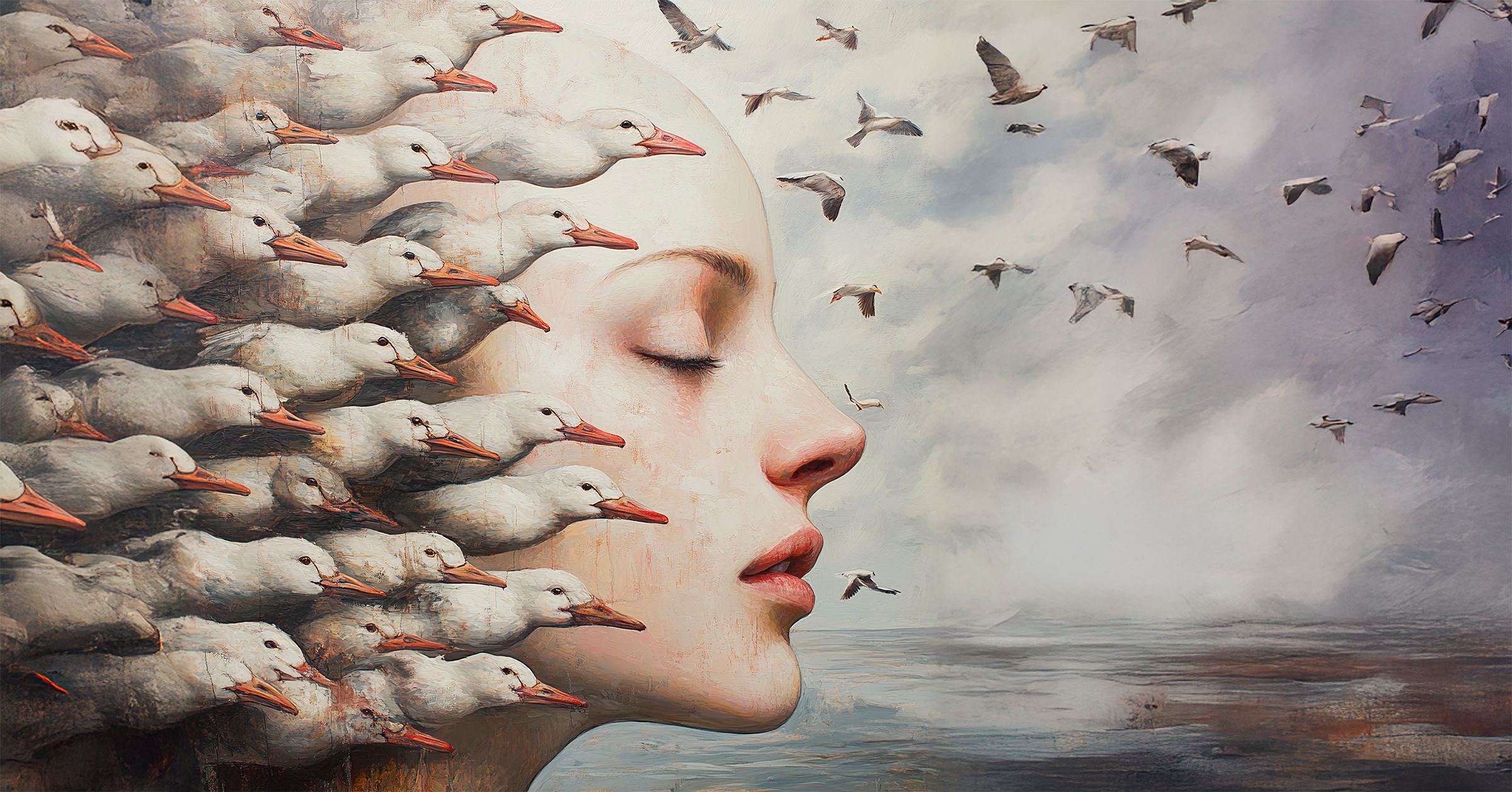
It’s like the glorious geese who have always laid golden eggs—eggs that shine in the sunlight, sparkling with uniqueness and imperfections—have changed. Suddenly they are laying eggs made of plastic, eggs that look and feel and sound like every other plastic egg on the shelf at Walmart one day after Easter.
I have used AI to write, too. It’s a little humbling to look back at pieces where I really leaned into it to help me compose something when I wanted to sound smart, but wound up sounding plastic.
The white-haired seer inside me is eternally forgiving, but she is also flashing sage advice with a futuristic neon warning sign: “Do not continue to follow this path.”
Instead follow poetry.
Messy handwriting.
Awkwardly human messages that wind up being endearing.
Write what’s real.
Your experience!
Like right now, my window is open. It is May Day here on Orcas Island, and thirteen different birds are singing. Each song is unique.
Like right now, I am looking at my office desk and notice the wood grains. The way they make waves, concentric light and dark layers that radiate out from each imperfection—tiny knots shape the waves into something interesting, dynamic, complex, and alive.
A fake wood desk wouldn’t have that richness. A flock of robot birds would sound weird. So does the AI writing.
Do not give your precious voice away so soon. The vulnerable place, sounding human because we are being human, bringing our voices outside of the machine, is where our power lives. Trust me on this.
And if you don’t believe me, believe the Academy of Motion Picture Arts and Sciences. On Friday they announced significant rule changes1, including that screenplays must be human-authored to be eligible for an Oscar. The Academy reserves the right to investigate the use of generative AI in any submission.
I’m apparently not the only one getting tired of AI writing!
On Resonance
Have you listened to The Telepathy Tapes? I’ve been tuning in through my earbuds as I garden. My hands and heart get grounded and healed by the dirt while my mind expands into realms where communication takes place without words.
I’d dare anyone to listen to the first 25 episodes and not come away believing that we humans all have within us the ability to communicate telepathically. This, this is part of what I mean when I say the future is feeling.
For now, we have words. I love words. Words can help us get closer to other human beings, or they can drive us further from each other. How we use words matters.
To be human is to feel. When we feel others, and they feel us, we come into resonance. And resonance is where the amplification of a message takes place.
But how on earth can we resonate with you—how can we feel you—when your message is generated by the plastic egg maker that is AI?
On Perfectionism
Why do we tend to fall for the lure of letting AI generate writing for us?
I think it is because the perfectionist who lives inside of us longs to create and connect, but is afraid of writing something that will cause us to feel shame. And sometimes it’s also because we are on a deadline to produce words, fast, and we want them to be good (i.e. not cause us to feel shame).
Brené Brown defines perfectionism as a “self-destructive and addictive belief system” that fuels the thought: “If I look perfect, live perfect, and do everything perfectly, I can avoid or minimize the painful feelings of shame, judgment, and blame.”2
The irony is, when we look perfect, live perfect, and do everything (including writing) perfectly we lose our humanity and become uninteresting to the very people whose love and acceptance and admiration and business we seek. When we let AI write for us, we think we sound good, but we often sound flat.
Let’s pinky promise each other that we’ll stop letting AI write Substack and blog posts, professional feedback, and personal emails.
Let’s pinky promise each other that we’ll write something real this week. From the heart, no matter how messy it is or how ashamed we might feel.
Let’s pinky promise each other that we’ll share those real, human, unedited words with at least one other soul who will appreciate them and encourage us to keep going.
I love us. We are so human! Let’s please stay human. Stay soft, stay curious, stay kind and… get back to laying those precious golden eggs.
Your voice is your signature. Make it golden.
[End of appeal]
PRACTICES | How to Stop Using AI to Write
Get a notebook.
Write some words down about what you’re thinking, feeling, experiencing. Get what is on your mind onto the paper. Let it be messy. Let it flow like a river or chop like an ocean. Write stuff down when you think of it. Be a secret poet.Open a voice notes app.
If writing by hand is really not for you at all, then use voice notes. Or do both. Transcribe your voice notes later in Otter.ai, or another transcription app. Voila - your own voice.Write from your heart.
Let go of the need for your writing to convince, control, or impress anyone. Write your experience. Write what your inner critic says is silly. Write garbage. Write gold. Write feeling. Write human. Write from someplace in your body that is below your chin. Trust that the authenticity of your intention will resonate more than the perfection of your prose.Trust yourself.
You are a better communicator than AI. You really are. Even if you are illiterate (and if you’re reading this you’re literate) you are a better communicator than AI. Trust me. Trust yourself.
Share your work with at least one other soul.
Share what you wrote, raw, with at least one person you can trust to appreciate what you are communicating and encourage you to keep going.
WORDS FROM WOMEN | (and a man)
BRENÉ BROWN, research professor, author, podcast host
“I call perfectionism the 20-ton shield. We think we carry it around to keep us from being hurt. But what it actually does is it keeps us from being seen. And it is so addictive.”3
FEDERICO FAGGIN, physicist, inventor of the microprocessor
“Telepathy is really a property that we all have at some level, to some extent, even when we don’t think that it is telepathy. For example, when people have love for each other and they communicate with love, they can understand each other at a much deeper level than when they communicate just with symbols because love is what actually allows the state of the fields to go into resonance with each other. It’s like a force. Resonance means the same meaning is in both entities. That’s why they understand each other much more deeply.”4
REESE WITHERSPOON, Academy-Award winning actress, producer, entrepreneur
“I don’t believe computers should replace humanity. I’m planning on learning as much as possible (about AI) so that I’m educated about this technological revolution. If you want to learn with me, great, let’s do this! If you don’t, that’s okay too.”5
It takes courage to be seen. There is power in connection. We have a responsibility to stay curious and open as the world evolves. We need your voice, powerfully unedited by AI.
When women trust their ferocity, they remake the world.
Thank you for reading The Ferocity Letter.
I write these words to encourage and empower you—and because I need them, too.
I have space this season for a new client! If you or a visionary woman you know is seeking a high-touch creative communications strategist and advisor, I’d love to connect.
Until next time, trust your ferocity.
— Laura
Laura Lowery is an advisor to visionary women. A communications strategist, writer, and founder of Light Advisors—she partners with purpose-driven leaders at threshold moments to give voice to your vision, elevate your presence, and empower you to communicate with clarity and resonance. Learn more: lightadvisors.co
Academy of Motion Picture Arts and Sciences, May 1, 2026, https://press.oscars.org/news/awards-rules-and-campaign-promotional-regulations-approved-99th-oscarsr.
Brené Brown, The Gifts of Imperfection: Let Go of Who You Think You’re Supposed to Be and Embrace Who You Are (Center City, MN: Hazelden Publishing, 2010).
Brown, The Gifts of Imperfection.
Ky Dickens, “The Inventor of the Microprocessor Questions Reality,” The Telepathy Tapes, Yellow Wing Productions, Season 2, Episode 24, October 15, 2025, https://thetelepathytapes.com/podcast.
Reese Witherspoon, Instagram Story @reesewitherspoon, April 22, 2026.